
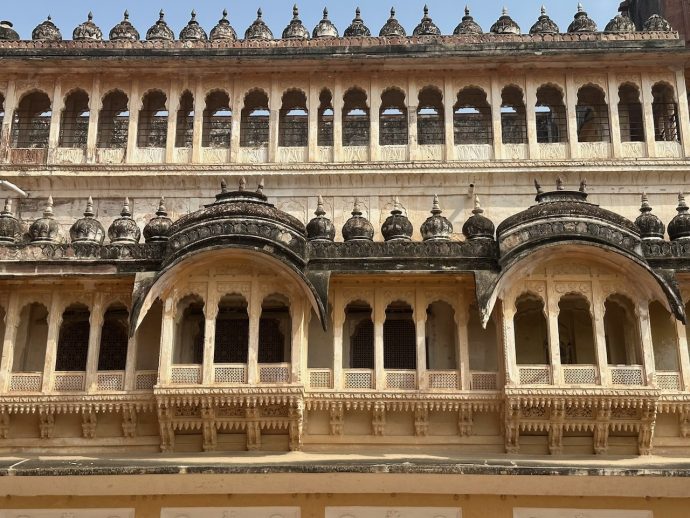
Rajasthan boasts a rich and extraordinary history, making it one of India’s most culturally diverse and fascinating regions to explore. Travelling through the state is a journey spanning more than a thousand years, taking in magnificent palaces and hill forts, exquisite art and architecture, ancient religious traditions and the stories of the powerful dynasties that shaped the region.
The name Rajasthan derives from Rājputāna, meaning ‘land of the Rajputs’, reflecting the powerful warrior clans who ruled much of the region for centuries. From the early medieval period onwards, Rajput kingdoms established themselves across Rajasthan, building fortified cities, elaborate palaces and temples, while developing distinctive traditions of art, architecture and courtly culture. Their legacy remains visible throughout the state today.
From the 16th century, Rajasthan came increasingly into contact with the expanding Mughal Empire. While relations between the Mughals and Rajput rulers ranged from conflict to alliance, a remarkable cultural exchange developed, particularly under the reign of Akbar the Great. Several Rajput rulers entered into alliances with the Mughals, while artists, architects and craftsmen moved between courts. Hindu and Islamic traditions consequently influenced one another, creating a distinctive cultural synthesis that can still be seen in Rajasthan’s architecture, decorative arts and royal collections.
Some of the finest expressions of this heritage are the Hill Forts of Rajasthan. Six spectacular forts – including those at Chittorgarh, Kumbhalgarh, Amber and Jaisalmer – are now recognised collectively as a UNESCO World Heritage Site. Built for defence but also functioning as centres of administration, religion and courtly life, they offer a remarkable insight into the power and ambition of Rajasthan’s historic kingdoms.
In Jaipur, our specialist guides will introduce you to the extraordinary City Palace, a complex developed by Maharaja Sawai Jai Singh II and his successors. Its architecture reflects the many influences that shaped Rajasthan, combining Rajput, Mughal and European elements. Nearby, the remarkable Jantar Mantar observatory reveals another side of Jai Singh’s intellectual curiosity. Its monumental astronomical instruments were designed to measure time and track the movement of celestial bodies with remarkable precision. Astronomy and astrology have long held an important place in Rajasthani culture, and continue to influence aspects of daily life, particularly marriage and other important occasions. Your guide can arrange a meeting with a local astrologer, offering a fascinating insight into this enduring tradition.
Alongside Hinduism and Islam, Jainism has played an important role in the religious and cultural life of Rajasthan for centuries. This can be experienced at the extraordinary Ranakpur Jain Temple, constructed in the 15th century and regarded as one of the great masterpieces of Jain architecture. The temple is renowned for its extraordinary marble carvings and the sheer intricacy of its design. At its heart is the Chaumukha Temple, dedicated to Adinath and distinguished by its forest of intricately carved columns, numerous halls and domed ceilings. In this atmospheric setting, you can learn more about Jain philosophy and traditions, and experience the living culture of the temple by joining Jain pilgrims for lunch.
By the 18th century, Mughal power was in decline and the political landscape of Rajasthan was once again changing. The Marathas extended their influence across parts of the region, while the British East India Company increasingly asserted its power in northern and central India. During the 19th century, most of the Rajput states entered into treaties with the British, retaining their rulers and considerable internal autonomy while accepting British paramountcy. Rajasthan consequently remained a collection of princely states rather than becoming a single unified political entity.
This period also brought new architectural influences. European, particularly Victorian, styles were combined with established Indian traditions in what became known as Indo-Saracenic architecture. In Jaipur, buildings such as the Albert Hall Museum reflect this fusion of influences, while grand residences such as Rambagh Palace offer a glimpse into the lavish world of the later princely states.
It is, of course, impossible to condense Rajasthan’s immense and complex history into a few paragraphs. From Rajput fortresses and Mughal influences to living religious traditions, extraordinary craftsmanship and the enduring legacy of its princely rulers, every part of the state reveals another layer of its past. Whatever your interests, our specialist guiding team will help you explore Rajasthan in depth, bringing its history, culture and people to life through exceptional experiences and encounters.